
Michelle Long Spears (D)
Commissioner District 2
“In my first term, we’ve made meaningful progress in addressing the challenges around court-held dogs through policy reform and stronger coordination between the county's law department, law enforcement and the courts.“
- Commissioner Spears on her previously demonstrated effort in support of animal welfare.
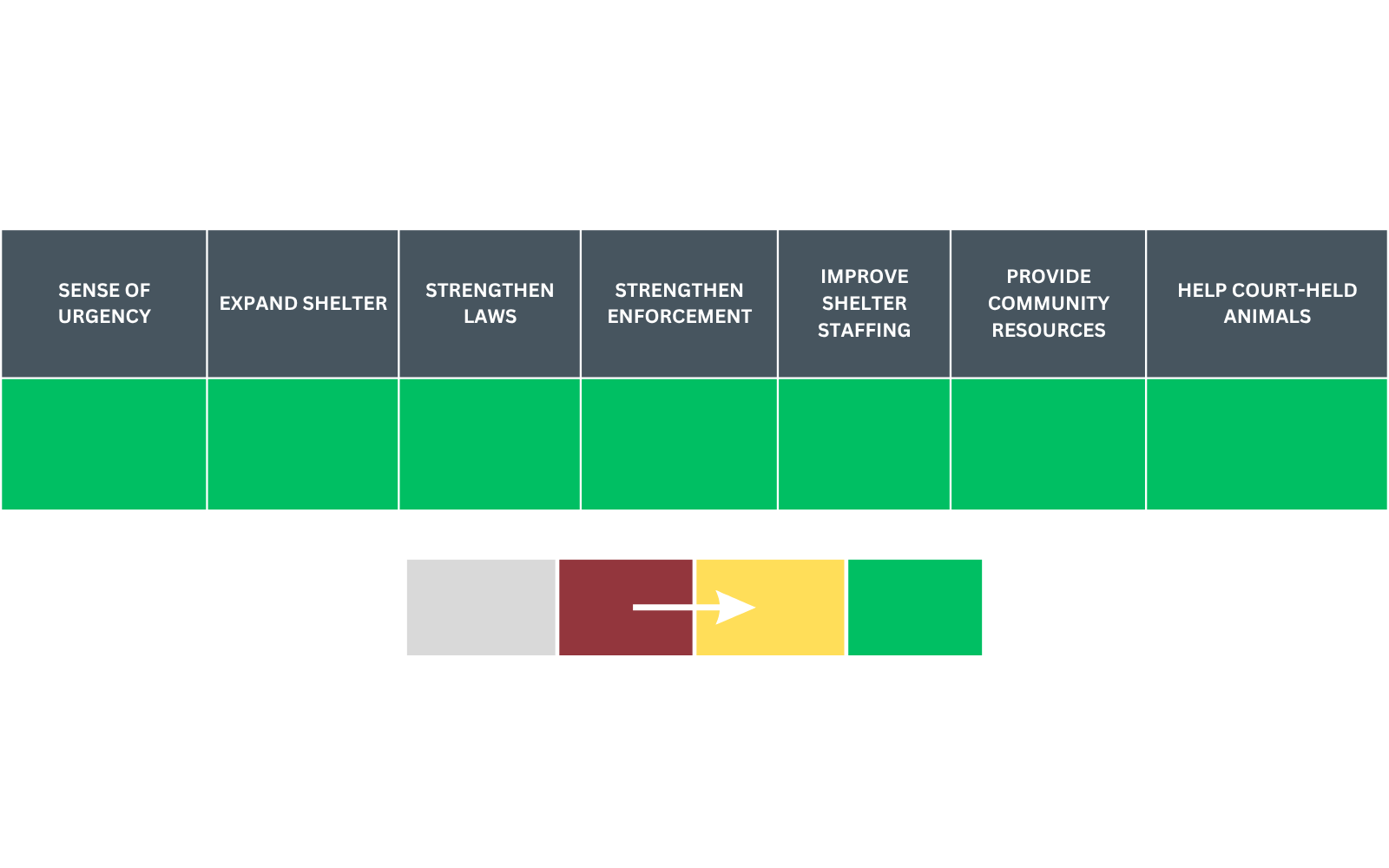
Summary By Position:
No Response —> Weakest —> Strongest
2026 Election Survey Responses
Responses are detailed below by subject matter and position. Candidate response summaries are a function of their expressed level of support (Commitment to Specific Activities) combined with timing priority (Commitment to Timeline).
-
How committed are you to expanding the current shelter to accommodate current and future needs during your term?
A: Very High CommitmentHire a licensed architect/architectural firm, with a successful track record of building right-sized, life-saving, no-kill animal shelters based on capacity needs.
A: Very High CommitmentCollect input, and assure its use in expansion plans, from Animal Services staff and volunteers, the DeKalb Animal Advisory Board, as well as the wider community.
A: Very High CommitmentUse the designated $7.5 million SPLOST II funds, and secure whatever additional amount is needed to complete the expansion.
A: Very High CommitmentWhat is your timeline for completing the expanded shelter for DeKalb County?
A: Within 1 yearPlease use this area to explain any of your answers to shelter expansion questions.
If you have previously worked on this issue, please describe how your efforts have addressed shelter overcrowding in DeKalb County.
Please also add any thoughts you have for addressing shelter overcrowding not mentioned above - we want to hear your ideas.
If you have nothing to add, please put "N/a."
A: “Expanding DeKalb County’s animal shelter is a critical step toward protecting both animal welfare and community wellbeing. Chronic overcrowding has strained the current facility, increasing stress on animals, staff, volunteers and resources while limiting the shelter’s ability to achieve positive outcomes.“
-
How committed are you to strengthening local ordinances to reduce and prevent homeless, neglected, and abused animals?
A: Very High CommitmentHow committed are you to ensuring the passage and enforcement of a new breeding and sales regulation?
A: Very High CommitmentSpay and Neuter How committed are you to mandating and enforcing a new spay or neuter requirement with pet registration?
A: Very High CommitmentHow committed are you to establishing an Animal Advocate for the County’s impounded animals?
A: Very High CommitmentHow committed are you to establishing an Animal Disposition Hearing process to reduce the number animals impounded for court cases and reduce their shelter stay?
A: Very High CommitmentWhat is your timeline for passing a new breeding and sales regulation as well as a spay and neuter requirement with pet registrations, once elected?
A: In the first yearPlease use this area to explain any of your answers to shelter expansion questions.
If you have previously worked on this issue, please describe how your efforts have addressed shelter overcrowding in DeKalb County.
Please also add any thoughts you have for addressing shelter overcrowding not mentioned above - we want to hear your ideas.
If you have nothing to add, please put "N/a."
A: “The transient sales and litter registry ordinances sponsored by my office and passed by the DeKalb Board of Commissioners represent important, proactive steps toward responsible breeding and population control in DeKalb County. By prohibiting transient animal sales and requiring breeders to register litters, these measures create greater accountability, discourage unregulated and high-volume breeding, and help close gaps that have historically contributed to shelter overcrowding. Together, these ordinances support a more humane, transparent system—reducing overpopulation at its source while reinforcing the County’s commitment to animal welfare and responsible pet ownership.”
-
What is your level of commitment to budgeting and filling enforcement positions commensurate with NACA standards?
A: Very High CommitmentWhat is your level of commitment to employing two POST certified officers to investigate and make charges related to neglect and cruelty, as well as provide training for all officers on record keeping and building strong cases?
A: Very High CommitmentWhat is your level of commitment to increasing training of field officers to improve skills related to bringing owners into compliance with local animal ordinances and state law?
A: Very High CommitmentWhat is your level of commitment to developing, implementing, and training all staff on a life-saving, public health and safety-based SOP Manual and System?
A: Very High CommitmentWhat is your timeline for funding enforcement positions. (i.e., increasing the staff numbers) commensurate with NACA standards once elected, and hiring two POST-certified staff?
A: In the first yearWhat is your timeline for ensuring all enforcement staff have received adequate training on bringing owners into compliance with local animal ordinances and state law?
A: In the first yearPlease use this area to explain any of your answers to shelter expansion questions.
If you have previously worked on this issue, please describe how your efforts have addressed shelter overcrowding in DeKalb County.
Please also add any thoughts you have for addressing shelter overcrowding not mentioned above - we want to hear your ideas.
If you have nothing to add, please put "N/a."
A: “My office championed (and will continue to do so) critical investments in strengthening our animal enforcement team—because effective enforcement is essential to protecting both animals and the community. This includes increasing staffing capacity, providing enhanced training to ensure officers are equipped to handle complex situations, and raising pay to better recruit and retain qualified personnel. In addition, establishing a new, dedicated office location improves coordination, response times, and overall service delivery. Together, these investments create a more professional, responsive, and effective animal services system for DeKalb County.”
-
What is your level of commitment to conducting a compensation study on shelter workers in DeKalb County and publishing findings on appropriate pay?
A: Very High CommitmentWhat is your level of commitment to budgeting and filling shelter positions commensurate with NACA standards?
A: Very High CommitmentWhat is your timeline for funding shelter staff positions commensurate with NACA standards and with pay informed by the compensation study's results, once elected?
A: In the first yearPlease use this area to explain any of your answers to shelter expansion questions.
If you have previously worked on this issue, please describe how your efforts have addressed shelter overcrowding in DeKalb County.
Please also add any thoughts you have for addressing shelter overcrowding not mentioned above - we want to hear your ideas.
If you have nothing to add, please put "N/a." A
A: “The data makes it clear: we cannot sustain a strong, functioning animal shelter without investing in the people doing the work. Our animal care staff are underpaid relative to the demands and trauma of the job, with wages far below the local living wage despite facing conditions comparable to other high-stress frontline professions. High turnover is a direct result of this imbalance and only worsens shelter operations and animal outcomes. That’s why I strongly support increasing pay to recruit, retain, and properly value these essential workers—because taking care of our staff is fundamental to taking care of our animals and our community.”
-
For pop-up veterinary services?
A: Very High CommitmentFor spay/neuter, microchipping, vaccinations, etc.?
A: Very High CommitmentFor pet food and supply bank(s)?
A: Very High CommitmentFor fencing and outdoor pet shelters?
A: Very High CommitmentWhat is your timeline for providing financial, logistical, and communications support for ongoing programs to increase access to all resources listed above (e.g., food banks, vet care etc)?
A: In the first yearPlease use this area to explain any of your answers to shelter expansion questions.
If you have previously worked on this issue, please describe how your efforts have addressed shelter overcrowding in DeKalb County.
Please also add any thoughts you have for addressing shelter overcrowding not mentioned above - we want to hear your ideas.
If you have nothing to add, please put "N/a."
A: “I strongly believe that keeping pets with their families is one of the most effective ways to reduce shelter intake. However, if the animal lands in our animal shelter due to no fault of their own, it is critical we secure a forever home as quickly as possible, which is why we’ve made significant investments in expanding community-based resources to keep pets in their homes and reduce the barriers of adoption. From launching Georgia’s first “pet neighborhood” to relieve overcrowding, to soon purchasing and deploying a mobile spay/neuter unit that brings services directly into high-need areas, we are meeting residents where they are. We’ve also supported high-quality, high-volume (HQHV) spay/neuter wet labs, trained veterinarians, hosted the mobile unit at community events (vaccinations, microchipping and basic care) and funded large-scale spay-a-thons to dramatically increase access to care. These efforts, combined with direct support for food, medical care, and supplies, reflect a comprehensive commitment to addressing the root causes of overpopulation while helping families keep their pets at home.”
-
What is your level of commitment to reduce the stay of all court-held animals, particularly dogs, during your term?
A: Very High CommitmentWhat is your level of commitment to establishing policies encouraging surrender by owner in the field and shelter?
A: Very High CommitmentWhat is your level of commitment to establishing a hearing process to determine disposition and release of animal(s) during court processes?
A: Very High CommitmentWhat is your level of commitment to utilizing a stray animal protocol for length of impoundment prior to release of court case animals? This would be when the owners do not contact the shelter after notice of impoundment.
A: Very High CommitmentWhat is your level of commitment to developing a partnership with prosecutors to utilize all options to release animals?
A: Very High CommitmentWhat is your level of commitment to developing a policy to use Motion to Dispose and Costs of Care in every case and in a timely manner where owners fail to appear or delay trial?
A: Very High CommitmentWhat is your timeline for establishing owner surrender policies?
A: In the first yearWhat is your timeline for establishing Motion to Dispose and Cost of Care policies?
A: In the first yearPlease use this area to explain any of your answers to shelter expansion questions.
If you have previously worked on this issue, please describe how your efforts have addressed shelter overcrowding in DeKalb County.
Please also add any thoughts you have for addressing shelter overcrowding not mentioned above - we want to hear your ideas.
If you have nothing to add, please put "N/a."
A: “In my first term, we’ve made meaningful progress in addressing the challenges around court-held dogs through policy reform and stronger coordination between the county's law department, law enforcement and the courts. In April 2024, we implemented a cost-of-care ordinance to ensure accountability and help offset the financial burden of long-term holds on the shelter system. Recently, we advocated for two new positions in the county government, including a Court Dog Coordinator in the Public Safety Department to better manage these cases and improve outcomes. In addition, the Interim County Attorney agreed to add a Paralegal in the Law Department to strengthen our ability to process cases more efficiently, helping reduce delays and move dogs through the system more quickly (and into a forever home as soon as possible).”